
A full understanding of the formation of the most massive galaxies remains elusive, as do key open questions in cosmology — most notably the Hubble tension. Forthcoming data from the Rubin Observatory and Euclid will revolutionize our view of both galaxy evolution and potentially contribute to explain the Hubble tension.
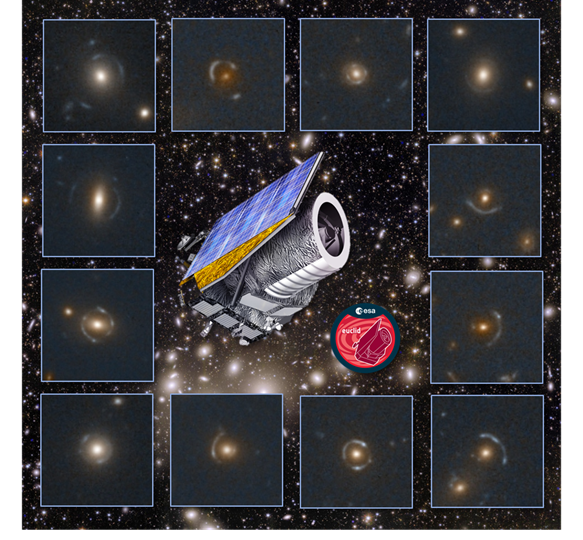
Thanks to its high spatial resolution and wide sky coverage, Euclid will open a new window on the Universe, potentially discovering hundreds of thousands of new galaxy-scale strong gravitational lenses, increasing current samples by two to three orders of magnitude (e.g., Walmsley et al. 2025). This unprecedented number of lenses, when combined with stellar populations, kinematic constraints and weak lensing, will enable precise measurements of galaxy masses, mass-density slopes, dark matter fractions, and the normalization of the stellar initial mass function (IMF), offering new insights into the physical processes that drive massive galaxy formation and evolution (Tortora et al. 2010, Tortora et al. 2013, Tortora et al. 2014, Tortora et al. 2018, Tortora & Napolitano 2022).
Meanwhile, the LSST@Rubin survey, though lower in resolution, will provide crucial temporal information for time-delay measurements in lensed quasars and supernovae, yielding independent constraints on cosmology and the Hubble constant. The vast Euclid and Rubin datasets will also demand advanced machine-learning techniques to efficiently identify and model strong lenses.
The proposed work within the LEPRE (LEnses as Probes of the universe with Rubin and Euclid) project is multifaceted, encompassing both methodological and scientific aspects. Depending on the student’s academic level (PhD, Master’s, or Bachelor’s), they will, at an appropriate level of complexity, focus on one or more of the following topics::
- Develop machine learning tools to identify and model strong lenses (following up our previous approaches (e.g. Petrillo et al. 2019; Li et al. 2021; Gentile et al. 2023; Busillo et al. 2025) and apply them to Euclid and Rubin data;
- Extend these techniques to joint Rubin+Euclid datasets, exploiting LSST’s multi-epoch observations to discover variable lensed sources (e.g. quasars, supernovae);
- Use other sets of data from KiDS, HSC, DES, JWST, etc. etc.
- Test these methods on mock data generated from simple prescriptions or cosmological simulations;
- Combine strong lensing models with stellar population and dynamical information to constrain dark matter fractions, IMF normalization, and mass-density slopes, and study their dependence on mass, redshift, and other galaxy properties;
- Interpret these results in the context of galaxy evolution using cosmological simulations (e.g. TNG, CAMELS, DREAMS);
- Develop machine learning and traditional methods to use strong lenses for cosmology, constraining cosmological parameters and, through time-delay lenses, the Hubble constant and explore the Hubble tension.
The work will be carried out at INAF–Osservatorio Astronomico di Capodimonte (Naples) under the supervision of Crescenzo Tortora (expert in galaxy evolution and gravitational lensing, member of the Euclid Strong Lensing SWG, and co-chair of the LSST Strong Lensing Science Collaboration), in close collaboration with experts in strong lensing and machine learning in the Napoli area and within Euclid and Rubin.
Contact: Crescenzo Tortora