
A full understanding of galaxy mass assembly, star formation histories (SFHs), and the effects of environment on galaxy morphology and stellar populations is still lacking. The combination of deep, high-resolution surveys from the Rubin Observatory and the Euclid mission, complemented by spectroscopic data (e.g. from 4MOST, WEAVE, and others), will enable an unprecedented characterization of spatially-resolved stellar populations in the Local Universe and beyond, up to more distant galaxies.
The unique optical–near-infrared coverage of Rubin and Euclid will unveil the “stellar backbones” of galaxies and their SFHs. By leveraging this multi-wavelength depth and resolution, the project will develop, test and apply deep-learning methods to extract pixel-level stellar population properties, alongside classical SED-fitting techniques, and will extend these analyses to higher redshifts.
Within PASTEL-RED (PAnchromatic view of STEllar populations in the Local universe and beyond with Rubin and Euclid Data), depending on the student’s academic level (PhD, Master’s, or Bachelor’s), the student will apply and refine these approaches, with an appropriate level of complexity, focusing on one or more of the following directions:
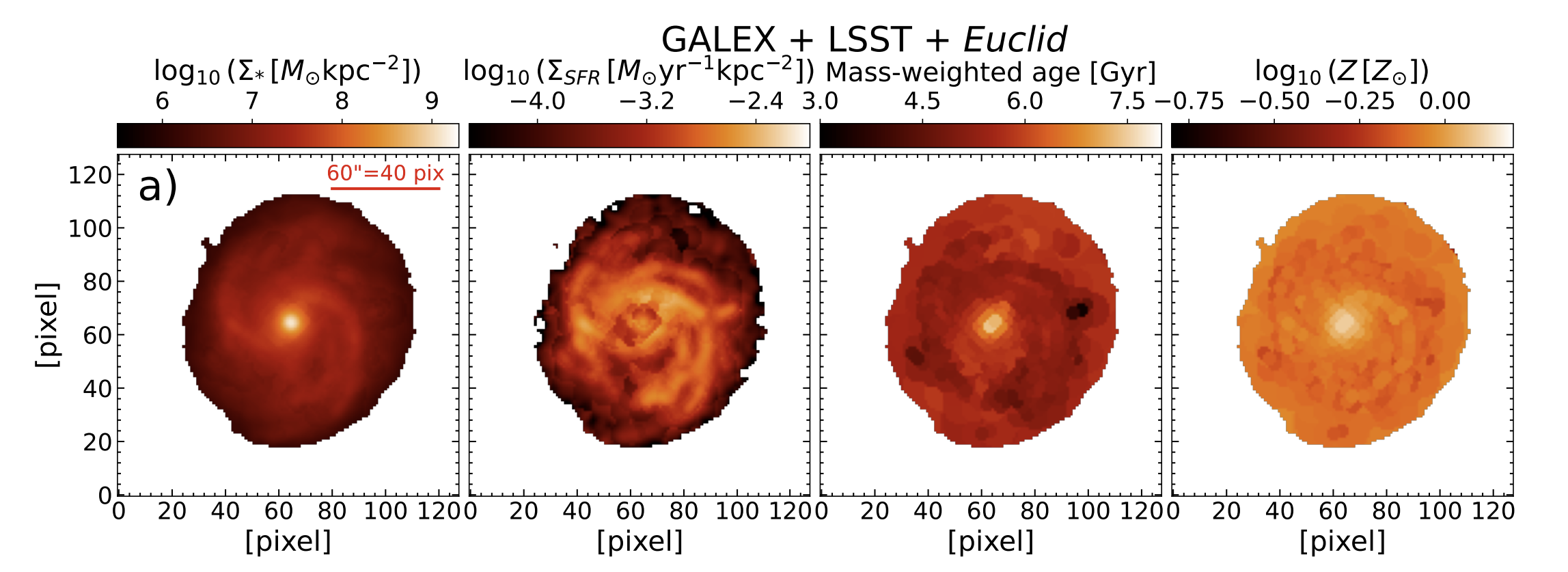
- Derive stellar population maps (see image below) from Euclid and Rubin imaging and spectroscopy using machine learning (e.g. Kovacic et al. 2025) and/or SED-fitting techniques (Abdurro’uf et al. 2025, Nersesian et al. 2025);
- Characterize galaxy structure and morphology using both deep-learning and traditional methods;
- Employ cosmological simulations (e.g. TNG, EAGLE, CAMELS) to test the methods (e.g. Abdurro’uf et al. 2025);
- Extend these analysis beyond the Local Universe, particularly to strong gravitational lenses discovered within Euclid (e.g. Walmsley et al. 2025), characterizing the stellar population properties of both lens and lensed source;
- Application to imaging from Euclid+Rubin, VST (e.g. VST-SMASH, Tortora et al. 2024), HSC, DES, etc., as well as to resolved and slit/fiber spectroscopy (e.g. WEAVE, 4MOST, etc.). The samples will include bright galaxies, but also newly discovered dwarf galaxies (Marleau et al. 2025), and faint features in the peripheries of the galaxies.
- Interpret the inferred galaxy properties as a function of mass, redshift, and environment, in connection with cosmological simulations (Tortora et al. 2025).
The work will be carried out at INAF–Osservatorio Astronomico di Capodimonte (Naples), under the supervision of Crescenzo Tortora (expert of galaxy evolution and strong lensing, lead of the WP on “Physical Parameters and Redshift” in the Euclid Local Universe SWG, co-chair of the LSST Strong lensing Science Collaboration, PI of the VST-SMASH survey), in close collaboration with experts in stellar populations, SED fitting, and machine learning in the Napoli area, as well as within the Euclid and Rubin collaborations.
Contact: Crescenzo Tortora