
Galaxy evolution, the nature of dark matter, and cosmology from dwarf to massive galaxies with Euclid, Rubin, and spectroscopic surveys
Understanding the structural evolution of galaxies and the fundamental nature of dark matter across cosmic time remains one of the greatest frontiers in astrophysics and cosmology. Galaxies span several orders of magnitude in mass, from fragile, shallow-potential dwarf systems to ultra-massive ellipticals. While massive ellipticals record the cumulative history of mergers and AGN feedback, dwarf galaxies are exceptionally sensitive to baryonic feedback processes and environmental mechanisms. Crucially, both extremes serve as sensitive laboratories to test cosmological paradigms and explore the nature of dark matter—probing whether it behaves strictly as Cold Dark Matter (CDM), or exhibits non-standard phenomenology such as Warm Dark Matter (WDM) or Self-Interacting Dark Matter (SIDM).
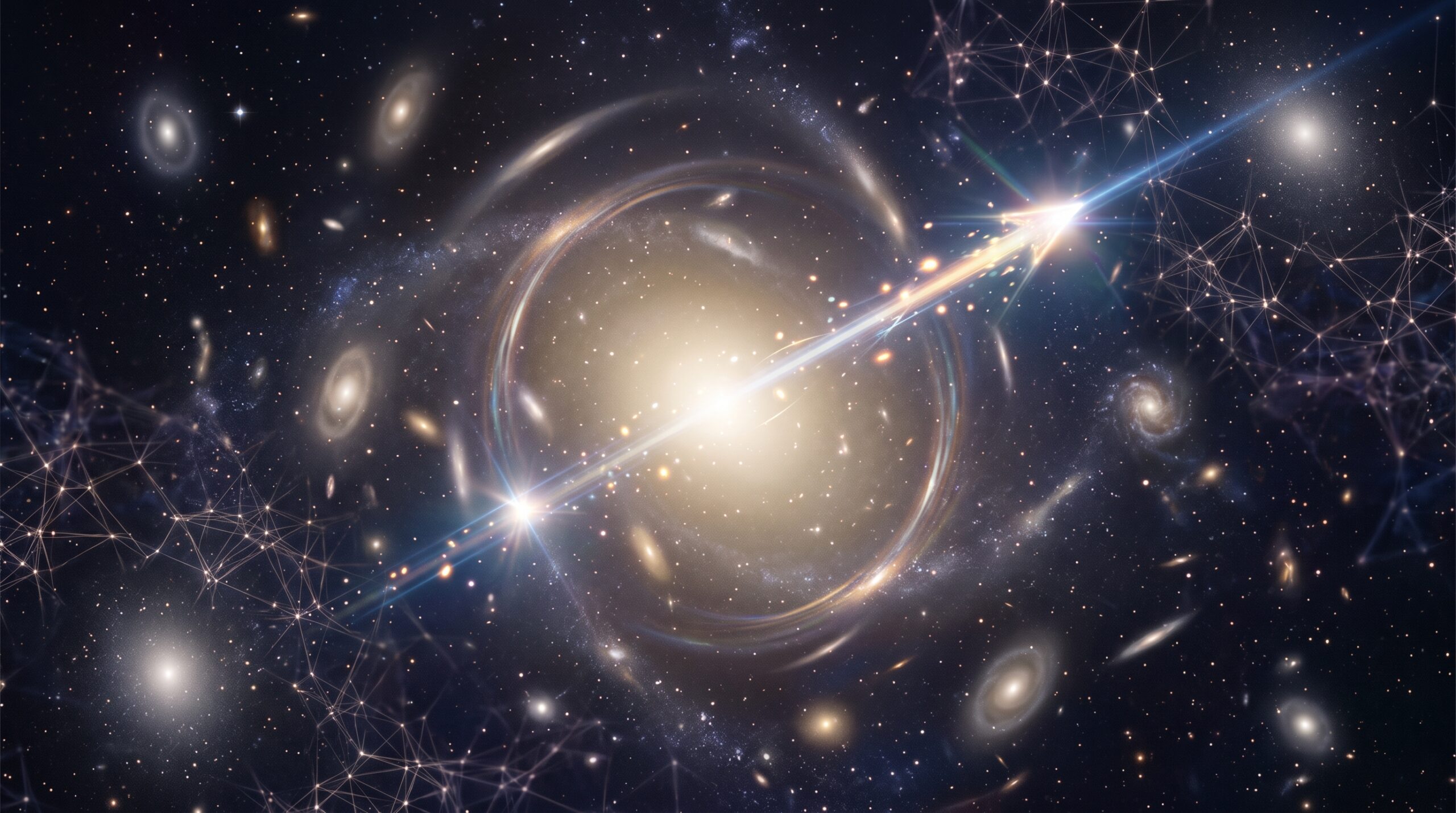
Concurrently, strong gravitational lensing provides an unrivaled, independent probe of the inner total mass distribution, dark matter fractions, and inner density slopes of massive galaxies, while also offering direct paths to constrain cosmological parameters (e.g., the Hubble constant H0 and the dark energy equation of state). The joint exploitation of the Vera C. Rubin Observatory’s Legacy Survey of Space and Time (LSST) and the space-based Euclid mission is opening a golden era: Euclid delivers exquisite, diffraction-limited spatial resolution across thousands of square degrees, discovering tens of thousands of new strong lenses and resolving galaxy structures up to high redshifts, while LSST provides unprecedented optical depth and multi-epoch cadences essential for variability and time delays.
However, extracting physical and structural parameters across the full mass range—as well as accurately identifying and modeling hundreds of thousands of strong lenses—poses an immense computational and methodological challenge that traditional fitting techniques cannot address at survey scale. This project aims to bridge galaxy evolution, cosmology, and dark matter physics by harnessing advanced machine learning and Bayesian deep-learning frameworks developed by our group. In particular, the project will exploit GALNET (Li et al. 2022) for high-throughput 2D structural parameter estimation (e.g., effective radii, Sérsic indices, magnitudes) across dwarfs and massive galaxies, and LEMON (Gentile et al. 2023, Busillo et al. 2026) for fast Bayesian neural-network modeling of strong gravitational lenses.
The project will focus on one or more of the following topics:
- Deriving robust structural parameters: Extracting half-light radii, Sérsic indices, and axis ratios across a wide mass spectrum (from dwarfs to massive ellipticals) using in-house deep-learning architectures like GALNET (Li et al. 2022) on Euclid and Rubin/LSST imaging, and benchmarking the results against classical profiling tools (e.g., GALFIT, SourceXtractor++);
- Upgrading and expanding GALNET: Further developing the GALNET architecture to perform multi-component decompositions (e.g., bulge-to-total ratios, B/T), enhance source deblending in crowded environments, improve training on complex structures such as spiral arms, and predict photometric redshifts and stellar masses directly from multi-band data;
- Bayesian deep learning for strong lensing: Applying and refining Bayesian neural-network frameworks (such as LEMON; Gentile et al. 2023, Busillo et al. 2026) to model galaxy-scale strong lenses discovered in Euclid and LSST, rapidly inferring lens light parameters, Einstein radii, mass-density slopes, lens mass distributions, lens/source redshifts, and lens stellar masses, complete with uncertainties;
- Investigating galaxy scaling relations: Analyzing scaling relations across both the general galaxy population and strong gravitational lenses (e.g., size–mass, color gradients, dark matter fractions, and mass density slopes), tracking their environmental dependence and cosmic evolution with redshift;
- Disentangling dark matter and IMF normalization: Combining strong lensing models with structural and stellar population measurements to break the degeneracy between baryonic and dark matter, constraining central dark matter fractions and the stellar Initial Mass Function (IMF) normalization;
- Targeting rare galaxy populations and relic galaxies: Exploiting the vast statistical power of Euclid and LSST to search for and characterize rare systems such as relic galaxies—compact, massive, passive high-z red nuggets that have evolved undisturbed without experiencing subsequent mergers—using their structure and abundance to test cosmological models and galaxy assembly paradigms (Tortora et al. 2018; Spiniello et al. 2024);
- Benchmarking with cosmological simulations: Performing systematic comparisons of observed scaling relations with state-of-the-art cosmological hydrodynamical simulations (e.g., IllustrisTNG, CAMELS; Busillo et al. 2023, 2025; Tortora et al. 2025). Applying both standard statistical comparisons (Busillo et al. 2023, 2025; Tortora et al. 2025) and novel machine-learning approaches (e.g. Qiu et al. 2024; Wu et al. 2024) it is possible to constrain both cosmological parameters (Ωm and σ8) and the strength of the physical processes (Supernovae and AGN feedback);
- Constraining the nature of Dark Matter: Testing cosmological models and the physical nature of dark matter (CDM vs. WDM vs. SIDM) by contrasting observed scaling relations, halo density profiles, and substructure abundances with theoretical predictions from simulations, leveraging our experience with CAMELS and DREAMS (Busillo et al. 2023, 2025; Silvestrini et al. 2026a,b) and upcoming SIDM suites;
- Incorporating spectroscopic data: Exploiting spectroscopic redshifts and stellar velocity dispersions from ongoing and upcoming surveys (e.g., 4MOST, WEAVE, and archival literature) to validate lens models and perform detailed dynamical and stellar population analyses;
- Cosmology and cosmography with strong gravitational lenses: Combining classical modeling techniques with advanced machine-learning pipelines to exploit strong lenses discovered in Euclid and Rubin/LSST for cosmological inference. This includes modeling time-delay lenses and lensed transients (such as quasars and supernovae) to derive independent constraints on the Hubble constant and address the Hubble tension, as well as exploiting large lens samples and complex configurations (e.g., double-source plane systems) to place stringent constraints on dark energy and cosmological parameters (Ωm and w).
Supervision & Affiliation. The proposed work within STRALE will be carried out at the INAF–Osservatorio Astronomico di Capodimonte (Napoli) under the supervision of Crescenzo Tortora (expert in galaxy evolution, dynamics, and gravitational lensing); co-chair of the LSST Strong Lensing Science Collaboration (SLSC); former lead of the “Physical Parameters and Redshift” WP within the Euclid Local Universe SWG, and currently lead of one of the Key Projects of the survey. Tortora is also a core team member of the WEAVE-StePS and 4MOST-StePS spectroscopic surveys, lead of the Working Group on spatially resolved stellar populations in the WAVES survey (4MOST), and lead of the Working Group “From the Local Universe to the Cosmic Noon” within the science team of MORFEO (the adaptive optics unit for the ESO ELT). Tortora is also co-leading the LSST in-kind contribution for determining structural parameters with machine learning.
The student will work in close synergy with colleagues and researchers in the Napoli area, as well as with international collaborators within Euclid Consortium (Strong Lensing SWG, Local Universe SWG, Galaxy and AGN evolution SWG), Rubin/LSST (Strong Lensing SC, Galaxies SC, Dark Energy SC), and 4MOST, gaining expertise in cutting-edge deep learning methods, structural and strong lensing analysis, and cosmological interpretation.
Contact: Crescenzo Tortora (crescenzo.tortora@inaf.it)
Website: https://www.crescenzotortora.com/